

Chrom/A
Jack Sal - CHROM/A
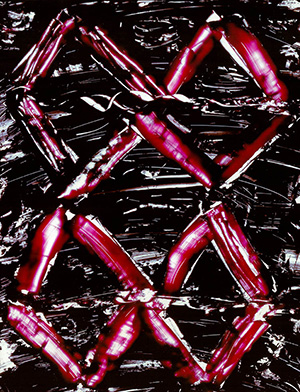
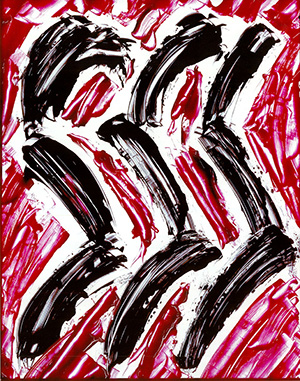
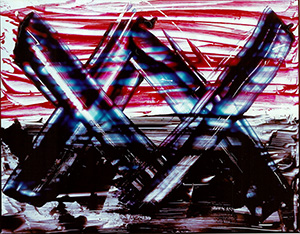
Chrom/A is an unpublished nucleus of works realized by Jack Sal with the use of the traditional photographic technique of cliché-verre (from the French term combining the words cliché = negative and verre = glass): a self-referentially created world in which the artist uses light and matter to transform photography within itself, demonstrating the subtle but profound bond with the physical world even in its most abstract/non figurative dimension. The unique aspect of these six clichés-verre - No Title - made in 1985 is the use of Cibachrome (today Ilfochrome Classic or more commonly Ilfochrome) by direct contact of painted plexiglass matrices with acrylic paint. The title, Chrom/A, refers to the English word chroma, which in optics indicates the magnitude defined by the differences between the chromatic coordinates of an illuminated body and those of a reference body of equal luminance, and is the central importance of color in this body of work, whose chromatic properties have remained unchanged over time due to the permanent fixed color. In the Eighties the debate of the acceptance of color in art photography was at a decisive stage: color photography had achieved recognition both aesthetically and conceptually as part of photographic practice. Purity and brilliance of color and clarity of the image, thanks to the Cibachrome material, replicate the light passing through the surface of plexiglass (drawings or paintings) to the print (photography). The glossy surface of photographic prints, together with the color and details of countless reflections inside the emulsion itself, determine a relationship with the painting on the surface of plexiglass, which is plastic but at the same time conceptually and physically transparent. “Moving in my work toward a more direct way of dealing with photographic representation, I came to work with a non-optical method. Using my own drawings on translucent papers, found objects and other materials, I began to form matrices that would still use the visual vocabulary of optically (camera) formed images but retain a more immediate relationship to the object from which it was made,” Sal writes in the catalog of the exhibition The Photographer's Hand (1980), curated by Susan Dodge Peters at the International Museum of Photography, George Eastman House in Rochester, New York. If in the making of other clichés-verre he drew with oil sticks, litho crayons and inks, in this series he made his pictorial signs using a pallet knife, not a brush: in this way the massing of acrylic paint creates a certain thickness. “The color is on the surface of plexiglass as an object,” Sal said. “The signs have a dimensional quality and the Cibachrome can represent this quality, because it does not have a diffuse color; there is clarity and focus. I like that these prints were made in New York on Broadway, near the corner of 8th Street, in a darkroom in the former studio of Ad Reinhardt who was an American painter and among the leading exponents of Abstract Expressionism and Minimalism. There is, therefore, a virtual connection with his work, specifically that of the last period, when he painted black on black. Yes, I like to think that I was doing art in the dark. This work is also linked to a very significant time in my personal and professional life: I had just had my first exhibition with Sol LeWitt at the Light Gallery in New York. After the opening of the exhibition I traveled, for the first time, to Europe where my work was acquired by museums in London, Paris, Amsterdam and Rome.” “One of the sources of Sal’s imagery is his knowledge of calligraphic script. Sal created grids out of Hebraic, Japanese or Chinese-like markings. His drawings, which are symmetrical, rhythmical and minimal, have remarkable visual poetry. He executes them on translucent papers, such as washi, rice and wax papers, which in turn act as negatives or matrices to be printed by the action of light onto photographic paper. Technically Sal’s clichés-verre are related to 19th-century “sun pictures,” the first works of one of the inventors of photography, William Henry Fox Talbot.” (Marilyn Symmes, Cliches-verre: Prints made without ink or press in Print News, April/May 1980, Vol. 2, Number 2). In particular, the gesture and its repetition construct is a visual paradigm expressing the duality of control and improvisation: It is, however, a gesture made by hand in that its reiteration will never be the same. “There is balance between stable and unstable, structure and variation. In these plexiglass paintings there is a structure, but there is also a bit of chaos and then there is the physicality of acrylic as well as the transparency of light.” Transparency also stresses another action, a sort of mirror game that could appear as a quotation of the negative on glass, although in this case Sal has consciously chosen to paint on a plexiglass support that is the same size of the Cibachrome paper, where it displays no edge but the creation of a continuous surface. “At a conceptual level it is important that Cibachrome is a positive/positive process; there is no negative. In my previous works in which I used other photographic processes using standard black and white gelatin silver paper and Printing Out Paper, when I was drawing or painting I chose a certain color with the knowledge of its interaction/reaction with the paper’s color spectrum sensitivity. Red, for example, blocks more light, while blue allows more light to pass through. Here, however, there is an equivalence between the painting and the print. This is not an interpretation of the system of representation as in black and white, but a replica. It is taking the world and reproducing it as a mirror image, rather than as a window onto the world. In Chrom/A there is also the reference to Duchamp, the use of glass and the idea of this great artist to create a work of art with a transparent support. I think it is significant that Duchamp’s work, The Bride Stripped Bare by Her Bachelors, Even (La mariée mise à nu par ses célibataires, même), most often called The Large Glass (Le Grand Verre), is in the collection and on permanent display in the Philadelphia Musem of Art, near the school where I studied and where, later, I returned to teach in another art school. In addition, an aspect that is interesting is how these Cibachromes are replicas in which the work is catalyzing the process. In my other clichés-verre you see my hand as well as the consistency of the support. Light passes through Chinese and Japanese handmade papers and glass displaying its transformational quality along with the physicality of the ink and pigment. Positive or negative, in this unique series of color clichés-verre, is a complicated process in which the positive becomes positive and the image occupies the entire space.”
|
|
|